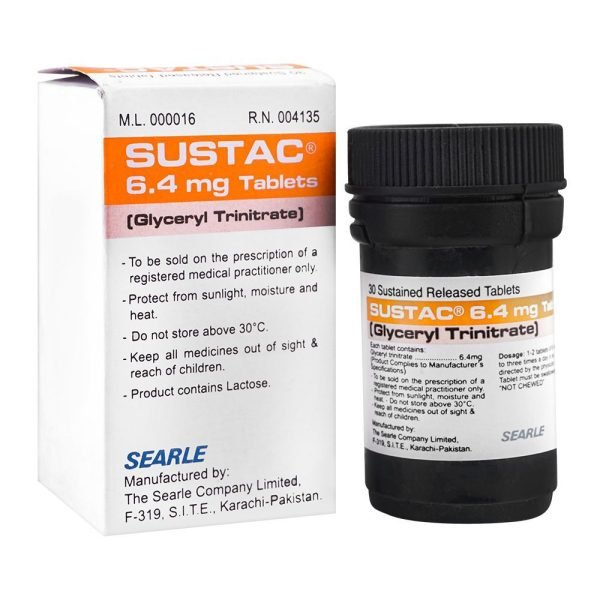
Usage And Safety
Dosage
Adults: 2.5-9mg 2-4 times daily upto 26mg 4 times/day. Children: Not recommended. Buccal Tablets: Adults: Initial 1mg every 3-5hr while awake ( 3 times day ); titrate dosage upward if angina occurs with tablet in place. Children: Not recommended. Sublingual Tablets : Adults : 0.2-0.6 mg every 5 min for max of 3 doses in 15 min; may also be used prophylactically 5-10 min prior to activities which may provoke an attack. Children: Not recommended OR As directed by your physician.
Side Effects
Very common (may affect more than 1 in 10 people):
• Throbbing headache.Common (may affect up to 1 in 10 people):
•Spinning sensation, fall in blood pressure when seated or standing up, dizziness, drowsiness
• lack of energy. Uncommon (may affect up to 1 in 100 people):
• Fainting
• facial flushing
• feeling or being sick
• localised burning sensation
• tongue blistering
• circulatory collapse.
Drug Interactions
Sildenafil, tadalafil or vardenafil, heparin, N-acetylcysteine, long acting nitrates (isosorbide dinitrate, isosorbide mononitrate, amitriptyline, disopyramide, atropine and propantheline, tricyclic antidepressants, apomorphine, ergot alkaloids)
Indication
It is indicated for the treatment of acute attacks of angina pectoris including variant angina and for the prophylaxis of such attacks.
When not to Use
It is contraindicated in patients who are hypersensitive to the active substance, to other nitro compounds, or to any of the excipients. Do not take Glyceryl Trinitrate tablets if you have anaemia.
Warnings
Warning 1
It should be used with caution in patients with cerebrovascular disease since symptoms may be precipitated by hypotension.
Warning 2
The use of medicinecould theoretically compromise myocardial blood supply in patients with left ventricular hypertrophy associated with aortic stenosis because of the detrimental effects of tachycardia and decreased aortic diastolic pressure.
Warning 3
If angina symptoms have not resolved after a total of three doses, the patient should be instructed to seek prompt medical attention